Introduction and context.
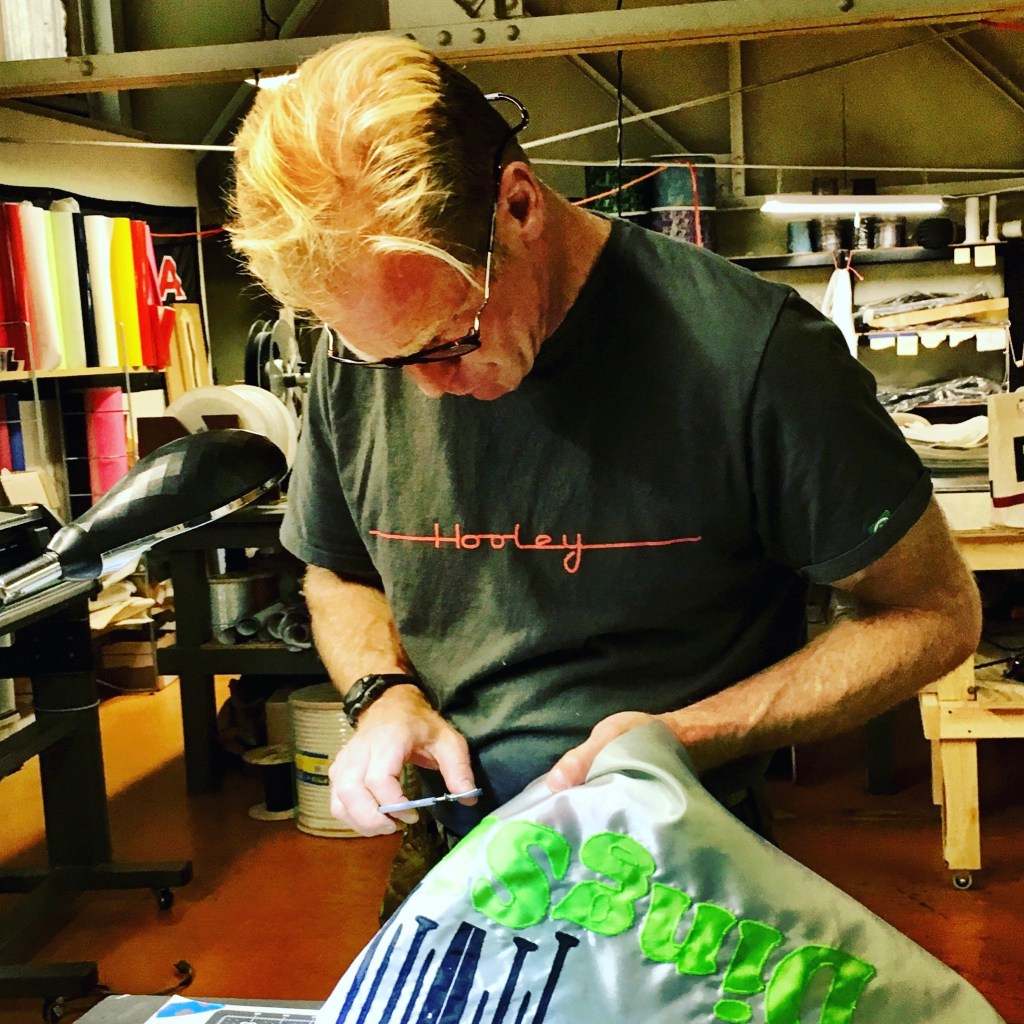
About ten years ago I learned to sew on an industrial sewing machine. The first and only lesson I got was from a mercurial and extremely talented Such African who had learned to sew as an intern in a hot air balloon factory in Germany. It was a dark and cold February evening – the time of year in Newport, RI when you’d rather not be here and most anybody who can afford not to be, isn’t.
Born and raised in apartheid era South Africa, Christian is ,fist and foremost, a waterman. The environment he grew up in was a perfect laboratory in which to foster and grow his love of adventure, ingenious and mischievous mind and innate irreverence. Landing in Newport as part of the crew aboard a large sailboat he decided it was time get off and Newport seemed as good a place as any.
Armed with the depth of his imagination and resourcefullness and the ability to sew very large pieces of fabric together – he decided to gather up a load of old sails being discarded by the millionaire boats lining the waterfront. He quickly set out to bring to life his idea of making duffle bags and totes and other such things out of this windfall. With little more than a credit card, second hand sewn machine and his raw talent and determination – he cut up the sails, stitched them into bags and sold them all at the local boat show that September. Another credit card, another couple of boat shows and before he knew it – he was business.
Working behind a desk, a phone and a computer all day, chasing and trying to explain numbers that are constantly subject to change and interpretation, I have always admired and, yes, envied, people who actually make something tangible that does not change shape or condition overnight. From the outside I had imagined that there must be a deep sene of satisfaction and gratification that comes from this. I enjoyed being around it and the people who’d figured out how to make a living at it and would find myself looking for ways to somehow find that for myself.
That’s when learned to sew. Not out of any forethought or plan – simply because it was 5:00pm, pitch black, freezing cold and I was sitting in a chair leaning against one of the many machines on his sewing loft floor as we amused ourselves with with stories of warmer days gone by or yet to come.
“Do you know how to use one of those”, Christian asked, gesturing to the very intimidating piece of machinery that had been my backrest. Knowing Christian well enough to know I’d never get out of giving it a go, I confessed my ignorance and braced for an education. Largely self-taught in most of his life’s skills, Christian pushed his beer aside and began to give me the lay of the land of my scary new surroundings. An industrial sewing machine is about the size of the engine in the back of my very first car – a dark green 1970-something VW Beetle. With his signature surfer’s brogue of Bro’s and Bra’s he explained how it worked, the path of the thread and the bobbin underneath and sped off sewing a stitch down a piece of scrap he’d pulled for a bin. “That’s pretty much it.” he declared with nonchalance. “Give it a go. You’ll figure it out.”.
The rest of the story deserves a post of its own but this is sufficient to set the scene for how I in turn had the good fortune to meet Bert Duguay. Sewing scraps of sail cloth from the sewing loft floor soon led to looking at virtually everything made of fabric and thread in a whole new light. One early summer afternoon on the transom of Christian’s lobster boat, I became transfixed with an appliqué sewn South African flag that the old flagmaker in Newport had stitched for him. Never one to miss a thing, seeing me trying to figure out how in the world one could sew fabric to fabric and cut it in just such a way that the colors all lined up perfectly, Christian flipped the switch for me. “You want a sewing project? Figure out how to do that. Those guys charged me $200 bucks for that. Now they’re gone. Closed up. Nobody knows where to get their flags made anymore.”
And so began my odyssey of making custom sewn flags in Newport, RI. To this day, amid the many frustrations of running a small business in the smallest state in the union, it has been far and way the most consistently gratifying business endeavor of my life. There is no question I owe the majority, honestly, all, of my success to two people. One of whom you just met. The other I’d like to introduce you to now.
Tribute to Bert Duguay
Newport lost a true character this week and at the Newport Flag Company we lost the guy whose life work inspired our quixotic idea of making custom sewn flags in one of America’s oldest cities.
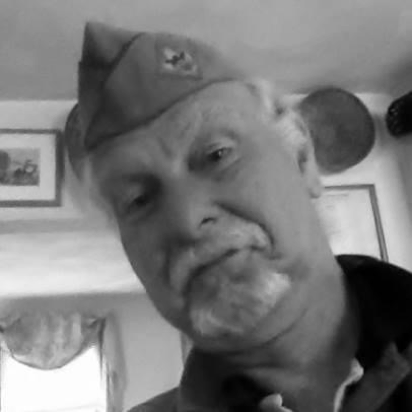
Bert Duguay – sporting his old Boy Scout cap (no doubt the grin he’s wearing with it is because he knows he was no boy scout…) was born and raised in the hardscrabble town of Woonsocket, RI. A history degree from Roger Williams University in hand, he moved down to Newport with his girlfriend (eventually wife, Liz) and his best friend and partner in crime. Answering an add in the local paper, he went to work for the Ebenezer Flagg Company, started in 1975 by Leo Waring to make flags for the upcoming Bicentennial. After Leo’s passing, Bert and a co-worker took the business over, operating out of a small shop at the intersection of Spring and Touro St. in the heart of Newport’s historic district. There he stitched custom flags for boats, shops, mansions and customers all over the country for more than 30 years.
I met Bert a few years after he’d quietly closed up shop and retreated to the peace and quiet of his home workshop down in his basement. Relieved, I think, to be done with the hassle of running a business, he was now free to enjoy what he loved, sewing flags. No rush. No customers. Not even anymore golf. Just some fabric, thread, a design and his trusty old Pfaff sewing machine sitting under a bare lightbulb hanging from the ceiling. There, amidst a stack of plastic bins, were the remnants of old flags he had made and half empty rolls of bright colored nylon – like pages in a scrapbook, each a chapter in the history of Bert Duguay and Ebenezer Flagg.
When I first knocked on his door I’m pretty sure he thought I was either crazy or trying to scam him. If Bert ever played poker I’d bet he didn’t lose often. His gruff exterior gave nothing away. Cajoled by as many questions as I could ask in between his cigarette breaks, he finally relented and agreed to come see the small space I’d set up and maybe teach me a thing or two about making flags. I will never forget the look on his face and the tear in his eye when, after one of those early visits, he turned to me and said, in his signature gravel voice, “I gotta tell you, bro, it’s good to be back in the game.”
For the last four years I’ve had the honor to see firsthand the care and detail he put in to (almost…but we’ll let those ones go, Bert!) every project I ever put on his table. Flagmaking is, as his sister put it so well in a recent tribute to him, a rare and unique endeavor. I suspect Bert quietly reveled in having mastered a skill you can’t learn in school or in books but which is instead handed down over time much like the history and stories behind so many of the flags he made over the decades.
Bert left this life much as he lived it – very much on his own terms and in his own surroundings. In this age of pandemic and quarantine I am relieved for him and his family that it was not a novel virus that did him in – that would not have suited Bert well at all. Instead, he was happily at home with Liz and his cat, I’m sure dressed, as always, as if he were about to step onto the first tee at the local golf course, no doubt a smoke or two into the day and gearing up to give somebody (OK, probably Trump) some hell on social media. And then maybe do a little sewing. True to the end.
Farewell, old Bert. You were a classic and I literally couldn’t have done it without you. I will do my best to keep your legacy going a bit longer. In my memory you are not unlike an old American flag that has come to the end of its day on the flagpole – a little faded and frayed around the edges but true to what it stands for and forever proud. Godspeed my friend.
Timothy Ely
Newport Flag Company
Newport, RI
April 22, 2020